
JSwipe – Jewish Dating & Love
JSwipeLifestyle
3.11.45K Reviews
- Version
- 4.6.11
- Installs
- 500.00K
- Age Rating
- Mature 17+
Screenshots






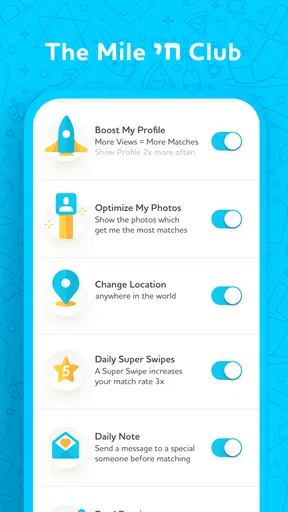
Our Review of JSwipe – Jewish Dating & Love
 Analysis by Appyee
I found JSwipe most useful when I treated it as a focused dating space rather than a replacement for every mainstream dating app. Its identity is clear: it is a Lifestyle app built around Jewish dating, and that focus can make the first conversation feel less awkward for people who want shared cultural or religious context from the beginning. At the same time, the narrower audience means the experience depends heavily on where you live, how far you are willing to travel, and how specific your expectations are.
My overall view is positive but selective. I would recommend it to Jewish singles who are tired of repeatedly explaining basic family traditions, holidays, or community references on general-purpose services. I would not recommend relying on it as your only option if you live in a small town, want a very large local dating pool, or prefer an app that keeps cultural identity completely separate from dating decisions.
What using JSwipe feels like in practice
The appeal becomes obvious during the first stage of meeting people. On a broad dating platform, shared background may be hidden behind several messages, and a promising conversation can lose momentum when two people discover very different expectations about faith, family, or long-term relationships. A Jewish-focused app moves that context closer to the surface. It does not guarantee compatibility, but it gives users a more relevant starting point.
The app is free to download, which makes trying it relatively low risk. Its mature age classification means it is intended for adults, and that matters here because the conversations can involve serious dating intentions, family expectations, and relationship boundaries. I would still approach every profile as an introduction rather than proof of character. A shared identity is helpful, but it does not replace ordinary judgment.
JSwipe is developed by JSwipe and has been available since December 2014. That long presence gives it a recognizable place in the Jewish dating-app landscape, while its reach extends beyond one city or one local community. The app presents itself as serving users in more than seventy countries, which is especially relevant for travelers, people who have moved away from home, and singles who want to meet someone connected to a broader Jewish community.
That international reach is both a strength and a practical complication. Seeing profiles from different places can make the service feel more alive than a strictly local community board, but distance quickly becomes important. Someone looking for a partner nearby should pay attention to location before investing time in a long conversation. Someone open to relocation, travel, or a long-distance relationship may see the wider reach as one of the app’s best qualities.
The focused audience is the main advantage
In my experience, the strongest reason to use this service is not a clever interface or a novelty feature. It is the reduction of cultural guesswork. A Jewish user who wants a partner familiar with Jewish life can begin from a more meaningful baseline than on a general dating app. That can save time, particularly for people who already know that shared tradition is important to their future relationship.
This does not mean every match will have the same level of observance or the same interpretation of identity. “Jewish” can describe many different lifestyles, from deeply religious to culturally connected, secular, progressive, traditional, or still exploring. I would therefore use the app’s focus as a conversation opener, not as a shortcut to assumptions. Ask what the person actually wants their background to mean in everyday life.
A useful approach is to move beyond the obvious opening message. Instead of sending a generic greeting based only on a profile photo, I would ask about the role of community, family gatherings, travel, or traditions in the person’s life. Those questions can reveal compatibility much faster than exchanging compliments. They also help distinguish someone who is genuinely interested in a relationship from someone who simply joined because the app’s audience sounded convenient.
The app’s average rating is around 3.1 from roughly 7,800 ratings, with about 1,400 written reviews. I read that as a sign to keep expectations realistic rather than as a reason to dismiss the service. Dating apps are judged by local activity, match quality, and individual goals, so a person in a lively Jewish community may have a very different experience from someone in an area with few nearby users.
A realistic evening with the app
Imagine someone who has just moved to a new city for work. They want to date, but they also want to find a partner who understands why family gatherings, Jewish holidays, or community involvement matter to them. On a general app, they might spend several evenings explaining those priorities before discovering that a match is not interested in sharing them. With JSwipe, they can start with a more relevant pool, then use the conversation to find out whether the shared label reflects compatible habits.
In that situation, I would set a practical search routine rather than swipe endlessly. I would review a small group of profiles, note whether the same people appear repeatedly, and give priority to profiles with enough personal detail to support a real conversation. If the local selection feels thin, I would widen the distance only if I was honestly willing to meet outside my immediate area. Expanding the search simply to create more matches can produce activity without producing realistic dates.
Another useful scenario is travel. A person visiting another country may use the app to discover whether there is a Jewish dating community in the destination. That can be appealing, but it needs careful boundaries: a profile in another country may be interesting without being practical. I would treat distant matches as social possibilities first and avoid making emotional commitments before discussing location, timing, and intentions.
Where the experience becomes frustrating
The biggest weakness is the tension between a clearly defined identity and the variety within that identity. The app can help you find Jewish singles, but it cannot automatically tell you whether someone shares your level of observance, your views on family life, your preferred relationship pace, or your plans for the future. If you expect the app to perform that deeper filtering for you, the experience may feel less precise than the concept suggests.
Local density is another serious limitation. A service can have users across many countries and still feel quiet in one particular neighborhood. If you repeatedly see profiles that are too far away, or if the same limited set of people appears over and over, the problem may not be your profile or your approach. It may simply be the size of the nearby community. In that case, using a mainstream dating app alongside JSwipe can be more sensible than forcing this one to do everything.
The free entry point is welcome, but the app also offers in-app purchases ranging from about two dollars to around one hundred twenty dollars per item. I would be cautious with spending until I knew that the local pool was active and that the app matched my dating goals. Paid tools can be worthwhile for someone who is already seeing promising activity, but they cannot create compatible people in an area where the audience is small.
This is an important trade-off: a specialized app may save time by improving cultural relevance, yet it can offer fewer practical choices than a large general service. A mainstream alternative is usually better for maximum volume, broad location coverage, or people who want to date without making religion or heritage part of the initial filter. JSwipe is better when that shared background is a meaningful requirement rather than a minor preference.
Small decisions that improve the results
I would begin by writing a profile that explains what Jewish identity means to me personally instead of relying on the app’s category to speak for me. A short, specific note about community, family, traditions, or the kind of relationship I want gives potential matches something useful to respond to. It also discourages conversations based only on appearance and makes mismatched expectations easier to spot early.
I would also avoid treating every match as a potential serious partner. The service is a way to meet people, not a guarantee that a shared background will translate into chemistry. A quick conversation about location and relationship goals can prevent a great deal of wasted time. If those basics do not line up, I would move on politely rather than trying to persuade the other person into a different life plan.
For users who are unsure about paying, my advice is to use the free experience as a local test. Check whether the profiles feel relevant, whether conversations begin naturally, and whether the distances are realistic. Only after answering those questions would I consider an optional purchase. The price range makes it especially important to understand what you are paying for and whether the benefit fits your actual use, rather than buying simply because a match has not appeared quickly.
Safety also deserves active attention. I would keep early conversations inside the app, avoid sharing sensitive personal details too soon, and arrange a first meeting in a public place. A Jewish dating focus may create a feeling of familiarity, but no app can verify that a stranger is trustworthy merely because you share a background. The same caution applies to requests for money, urgent travel plans, or pressure to move faster than feels comfortable.
Who should choose it, and who should look elsewhere
I think JSwipe is a strong fit for Jewish singles who want cultural relevance at the start of the dating process. It is particularly suitable for someone who wants to discuss family, tradition, community, or faith without treating those subjects as an awkward disclosure. It can also suit people who have moved away from a familiar community and want a wider way to meet other Jewish singles.
I would be more hesitant to recommend it as the only dating app for someone in a small or remote area. I would also suggest a general service first for a person whose priority is the largest possible local pool, the broadest range of identities, or highly detailed compatibility tools. Someone who wants complete separation between dating and religious or cultural identity may find the central premise less appealing.
It may also be a poor match for anyone expecting instant certainty. The app can reduce one kind of mismatch, but it does not eliminate the work of dating. You still need to read profiles carefully, ask direct questions, judge consistency, and decide whether your lives could actually fit together. The best results come from using the community focus as a filter, not as a substitute for curiosity.
On the technical side, the current version is 4.6.11 and it supports devices running Android 5.1 or later. That makes it accessible to people using older compatible Android phones, although I would still keep the app updated when possible for a smoother experience. The service has passed half a million installs, enough to show that it is more than a tiny experiment, but that overall figure should not be confused with the number of active, nearby people available to you.
My final recommendation
After weighing the focused audience against the uneven local availability, I see JSwipe as a useful specialist tool rather than a universal dating solution. Its best quality is simple but meaningful: it gives Jewish singles a place to begin with a shared point of reference. That can make conversations more relevant and help people avoid repeating the same explanation of their background on every new match.
Its limitations are just as clear. Identity does not equal compatibility, international reach does not guarantee nearby dates, and optional purchases deserve restraint until the local experience proves worthwhile. The mature audience, free starting point, and established presence make it easy to try, but the decision to stay should depend on the quality of conversations rather than the number of profiles.
My recommendation is to try JSwipe alongside, not necessarily instead of, a broader dating app. Give it a fair test with an honest profile, realistic distance settings, and clear questions about lifestyle and relationship goals. If shared Jewish identity is central to the relationship you want, this app can make the search feel more purposeful. If your priority is sheer choice or highly granular matching, another service may serve you better.
In short, I would recommend it to the right person with confidence, but not without conditions. It works best when you value cultural context, live within reach of an active community, and are willing to do the remaining compatibility work yourself. For that audience, the focused approach is genuinely useful; for everyone else, it may feel narrower than the larger alternatives.
Verdict
Strengths of JSwipe – Jewish Dating & Love
- Designed specifically for Jewish singles seeking culturally compatible matches.
- Simple swipe-based interface makes browsing profiles quick and intuitive.
- Location-based discovery helps find potential matches nearby.
- Profile details can highlight Jewish background, traditions, and preferences.
- Useful for users seeking relationships with shared religious or cultural values.
Limitations of JSwipe – Jewish Dating & Love
- Smaller dating pool outside major cities or areas with Jewish communities.
- Some features and visibility options may require a paid subscription.
- Match quality depends heavily on the completeness of user profiles.
- Users may encounter inactive profiles or limited recent activity.
- Religious and cultural expectations can vary widely between members.
Similar Picks in This Category
View All
SmartThings
Samsung Electronics Co., Ltd.4.6

Google Home
Google LLC4.0

Pinterest4.2

Astrotalk - Talk to Astrologer
Astrology & Horoscope4.7

My Verizon
Verizon Consumer Group4.5

Samsung Wallet (Samsung Pay)
Samsung Electronics Co., Ltd.4.1
Frequently Asked Questions
What is JSwipe – Jewish Dating & Love, and who is it designed for?
JSwipe is a dating app created primarily for Jewish singles looking to meet people who share their cultural, religious, or family background. While many members use it with the goal of finding a serious relationship or marriage, the app can also be used to make new connections and explore dating possibilities. Users should remember that the community includes people with different levels of religious observance and relationship expectations.
How does matching and messaging work on JSwipe?
JSwipe uses a swipe-based system familiar from many modern dating apps. You can browse profiles, view photos and personal details, and indicate whether you are interested. When two users express mutual interest, a match is created and messaging generally becomes available. Before starting a conversation, it is worth reading the profile carefully, since preferences about location, observance, lifestyle, and long-term intentions can vary considerably between members.
Does JSwipe offer free features, or is a subscription required?
JSwipe typically provides basic dating features at no cost, allowing users to create a profile, browse potential matches, and interact within certain limits. Additional tools may require in-app purchases or a premium membership, depending on the current version and region. Paid options can include expanded discovery features, enhanced visibility, or more control over matching. Always check the app’s current pricing and subscription terms before purchasing.
Is JSwipe safe and private to use?
JSwipe includes standard dating-app safety options such as profile controls, reporting, and blocking, but no platform can completely eliminate scams, fake profiles, or inappropriate behavior. Avoid sharing your home address, financial information, passwords, or sensitive personal documents. Keep early conversations inside the app, arrange first meetings in public places, and tell someone you trust about your plans. Review the privacy policy to understand how profile information and photos are handled.
What should I include in my JSwipe profile to get better matches?
A complete and honest profile usually gives you the best chance of attracting compatible matches. Use clear, recent photos that represent you naturally, and write a short description covering your interests, lifestyle, location, and what you hope to find. If Jewish identity, traditions, or religious observance are important to you, explain that respectfully without making assumptions about others. Thoughtful details can help start meaningful conversations and reduce unsuitable matches.
